

Hidden in Plain Sight
Female Vulnerability as Performance and Plot Device in Contemporary Horror

This essay contains spoilers for the movies Midsommar, Strange Darling and Weapons - I’ll flag the spoiler-heavy sections as we go
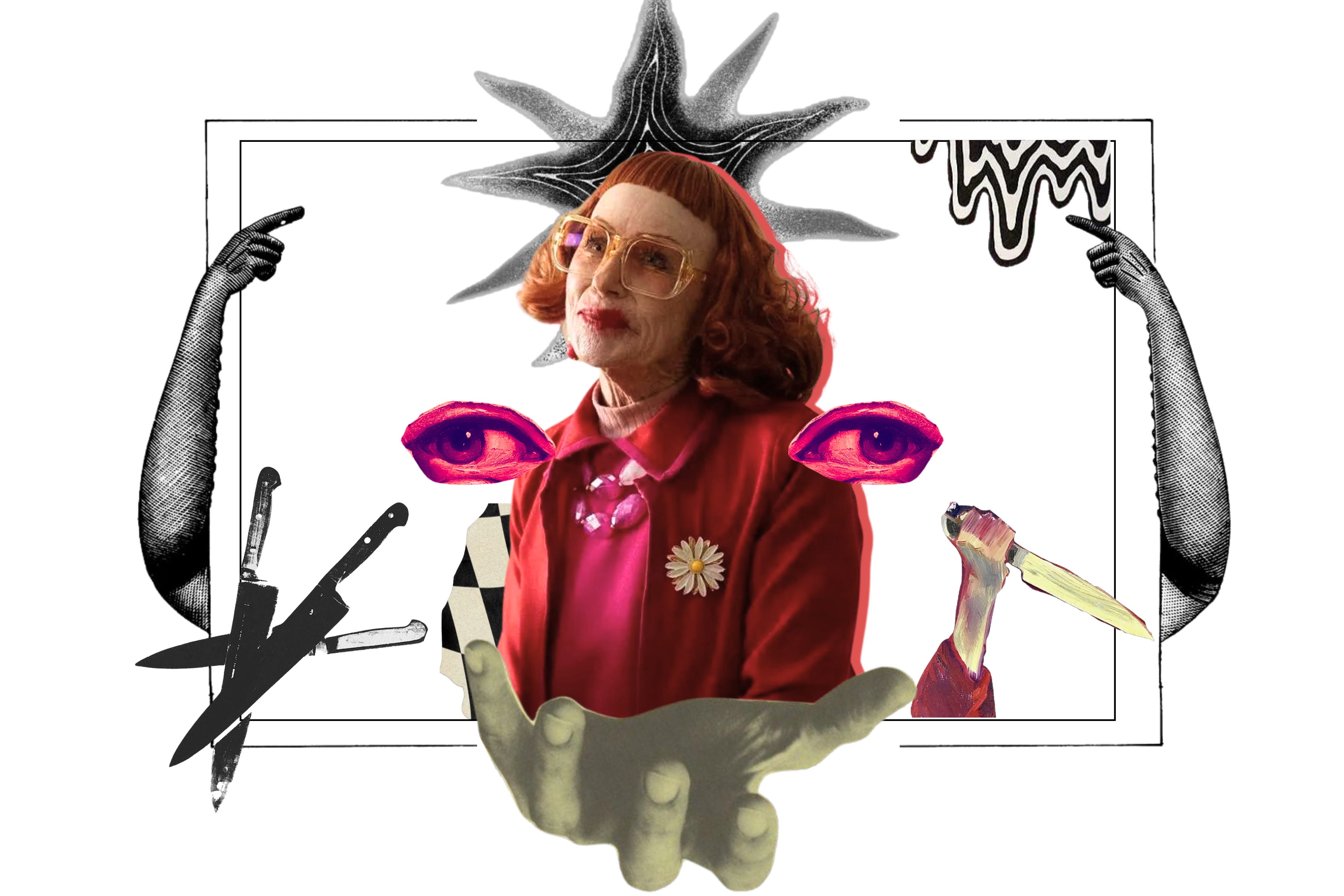
What is the role of horror movies besides cheap thrills from the comfort of a couch? If we believe the words of Barbara Creed1, first film theorist to actually reflect on female monsters on screen and what they say about societal anxieties, horror movies function as modern purification rituals, in a similar way to religion. A bold claim? Maybe, but let me walk you through it.
Horror as Purification Ritual
Horror is folklore; it pushes the boundaries of terror and asks us to confront the abject2 (corpses, bodily waste, you name it) in order to ‘redraw the boundaries between the human and the nonhuman.’ In other words, horror movies stage a crossing between the symbolic order (civilisation)3 and the abject (horror), only to restore boundaries in the end. That way, horror makes it clear what belongs in the human world, and what ought to be expelled.
Of course, horror movies are not notorious for their happy endings. Sometimes, the villain wins, or leaves irreparable damage. But the purification ritual of horror is not about the defeat of the monster, but about making it clear who and what is threatening to civilization as we know it, and needs to remain outside.
Feminist Era Witches
Take one of the most used monstrous-feminine figures: the witch. Always feared, sometimes admired, the witch is a prime example of an abject figure used in horror movies to repulse and terrify. Through her depiction as abject (surrounded by repulsive things, and often depicted herself as abject) and with un-womanly characteristics (dangerous and utterly selfish), the witch is often a clear antagonist in horror movies, here to destroy the innocent community she infiltrated.
But as Payton McCarty-Simas, author of That Very Witch, explains4, this type of depiction of the witch is characteristic of moments of resurgent conservatism (the 80s, the 2000s), where the witch “loses some or all of her power to frighten, often taking on a more comedic cast.” But during periods of heightened feminist activism (the 60s, the 90s, the 2010s), it’s more common to “see powerful witches proliferate in the horror genre.”
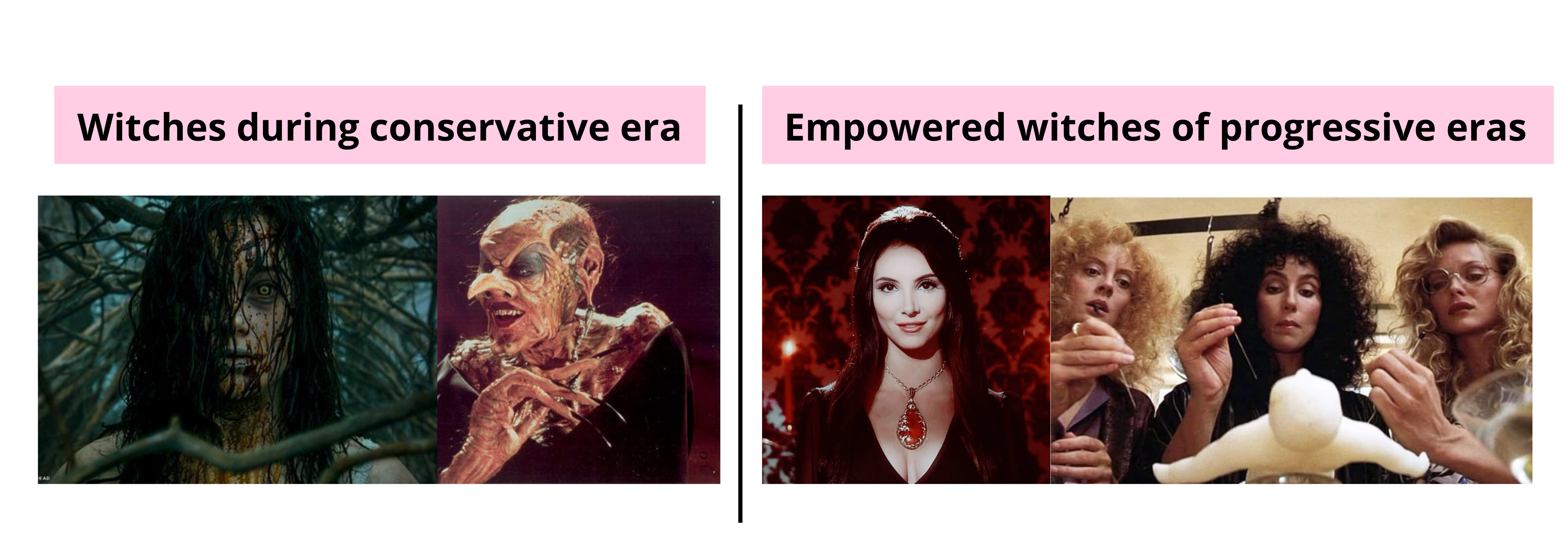
And so, for instance, horror movies of the 2010s were more likely to use abject female figures, not to terrorise, but to question the patriarchal order in place. If the witch traditionally messes with the symbolic order at large, the empowered witch of the 2010s is represented with powers that are a threat to male power specifically. In Midsommar and The Witch, two horrors occur at once: danger is lurking and palpable; something non-human is threatening the community they belong to. But the real danger is increasingly revealed to be the community they thought they were a part of. The ‘threat’ becomes the woman’s very power against an oppressive society.
In Midsommar, the horrors are twofold: a group of young Americans are trapped in a sinister Swedish folk commune, while Dani, our female protagonist, navigates extreme grief. She relies on her long-term boyfriend, Christian, who completely neglects her, makes her feel like a burden while being too much of a coward to even break up with her.
This paragraph contains spoilers for Midsommar:
As the commune’s hostile practices escalate, so does Dani’s realisation that her boyfriend is cruel. She warms up more and more to the commune that, in spite of its homicidal tendencies, offers her sisterhood and unconditional support. And so Dani ends up on the side of the entity that was framed as a threat all along, while the audience is made to root for her as she watches her boyfriend burn alive with a smile on her face.
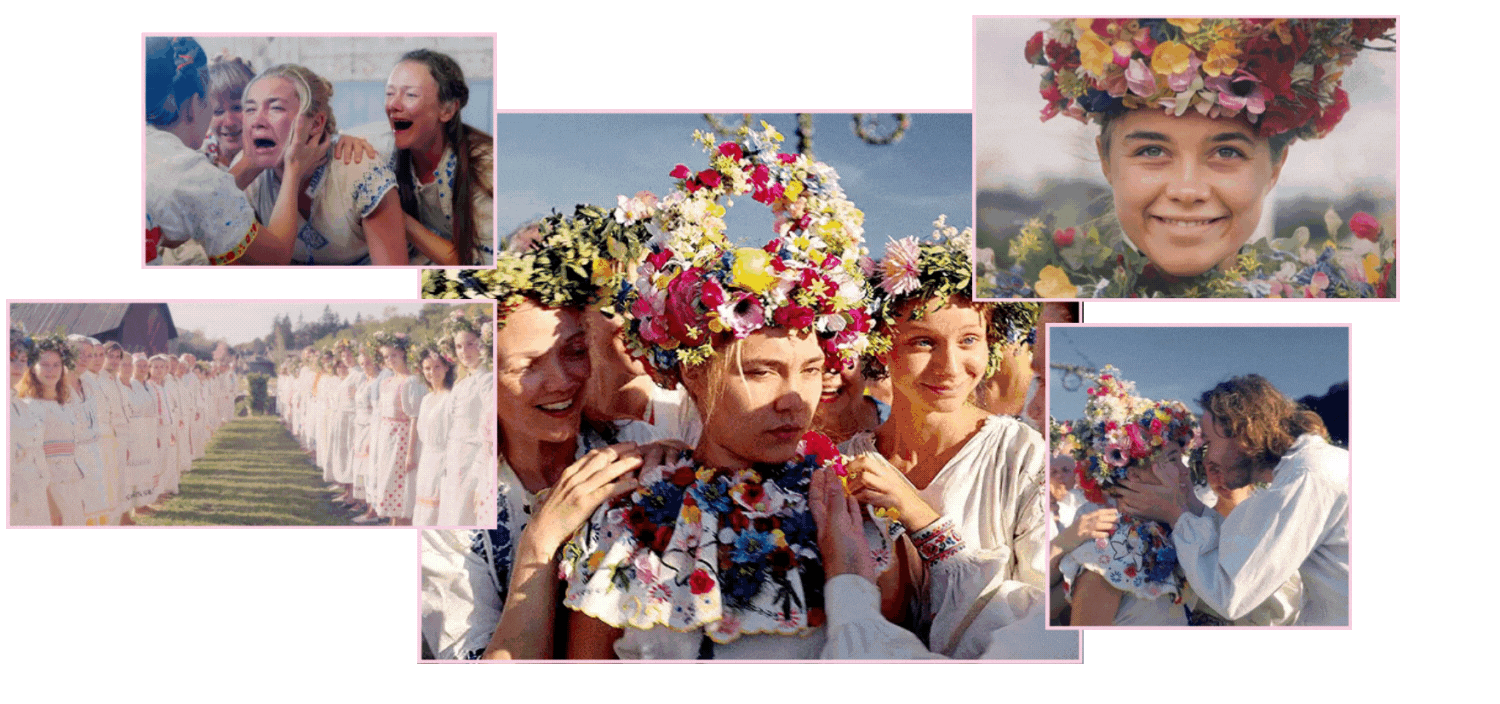
While these movies align the female protagonist with the abject and the monstrous-feminine, the audience is still made to root for her. We witness how these women were pushed into these roles by a symbolic order that never had their best interest at heart in the first place. In that sense, society becomes the real monster of the story, and we understand why she’d leave it behind.
I think this was a really fun, refreshing era of monstrous-feminine depiction on-screen. But things are shifting. If horror functions as a mirror to cultural progress and anxieties, it makes sense that in a post-Me Too era marked by rising authoritarianism, horror is adopting a different stance when it comes to female power and villainy.
In this essay, I want to talk about two recent movies, Strange Darling and Weapons, that are products of this era and share a narrative formula: the idea of the female monster as hidden in plain sight, performing vulnerability to infiltrate and destroy for their own gain.
Preys as Predators
This whole section contains major spoilers for the movie Strange Darling
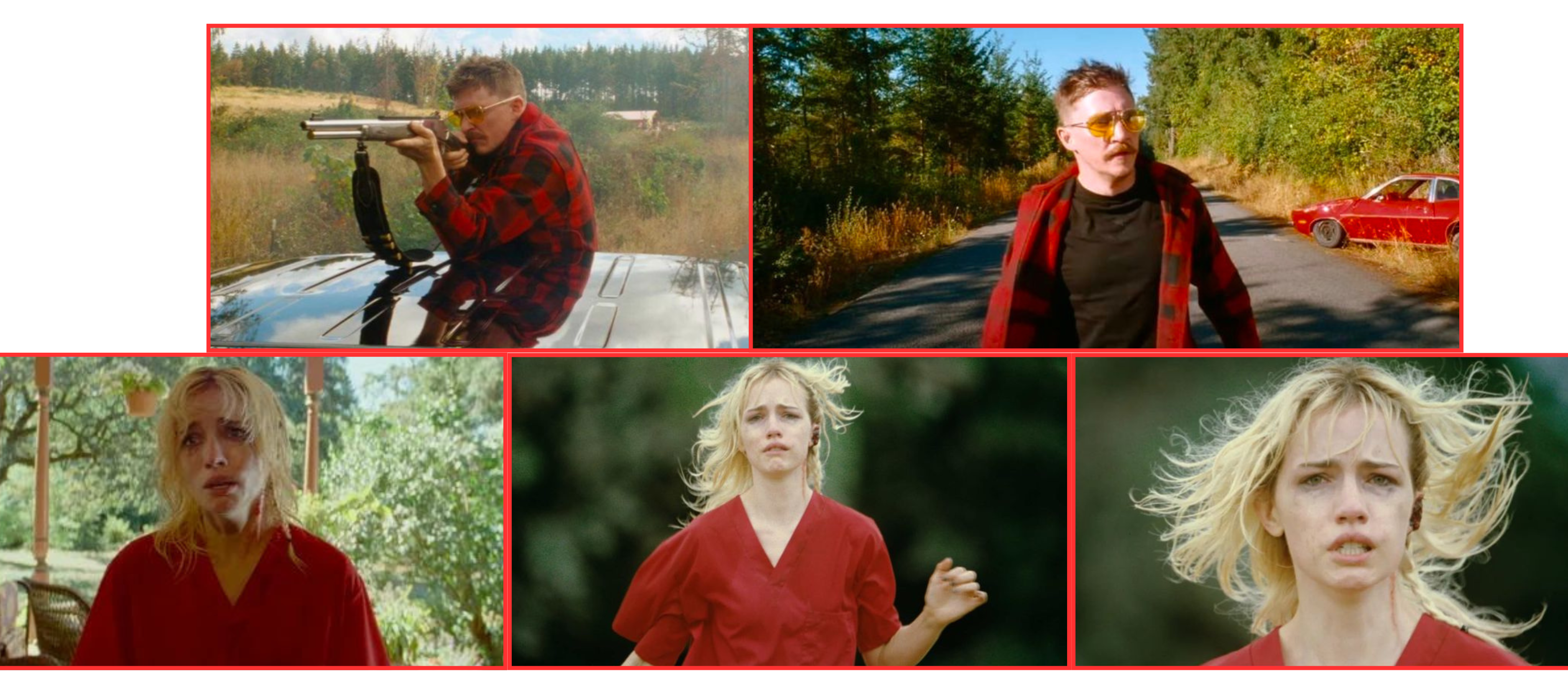
Strange Darling opens with two vivid shots: a shot of a man’s upper body strangling a woman, and a steady shot of a woman running towards the camera, a panicked look on her face. As she gets closer to the camera, we realise that blood is running down her face. Another shot: a man in a car, racing behind a woman also in a car, the same woman we saw in the previous shot. She looks panicked, he looks focused. He stops the car, gets a rifle out, and aims at her. Our protagonist has everything of a predator. “Chapter 3” is announced—the story will be told a-chronologically—its title: “can somebody help me?”
Strange Darling evokes a classic American serial killer movie, a game of gendered cat and mouse that feels all too familiar to the public, even for those who were not born during the pocket of time when male serial killers were roaming around the United States on killing sprees.
But Strange Darling is a movie that spins this expectation on its head. Quickly, it is revealed that the wounded woman who is framed as the victim is actually the serial killer, while the man framed as a serial killer is nothing but her prey. The story is told in a disjointed way so as to subvert the audience’s expectation: who you think is the victim here is actually the predator.
One scene cements the obvious subtext: the female protagonist, now alone and handcuffed by the male protagonist, manages to pull her own pants down to fabricate an apparent rape scene before the cops arrive. When the police arrive, the female cop rushes to help, while her male colleague hangs back, doubtful, asking “what really happened here?” Later, as the female protagonist turns a gun on them, revealing that she tricked them all along, the female cop is stunned, while her colleague shakes his head knowingly, murmuring “you dumb bitch.”
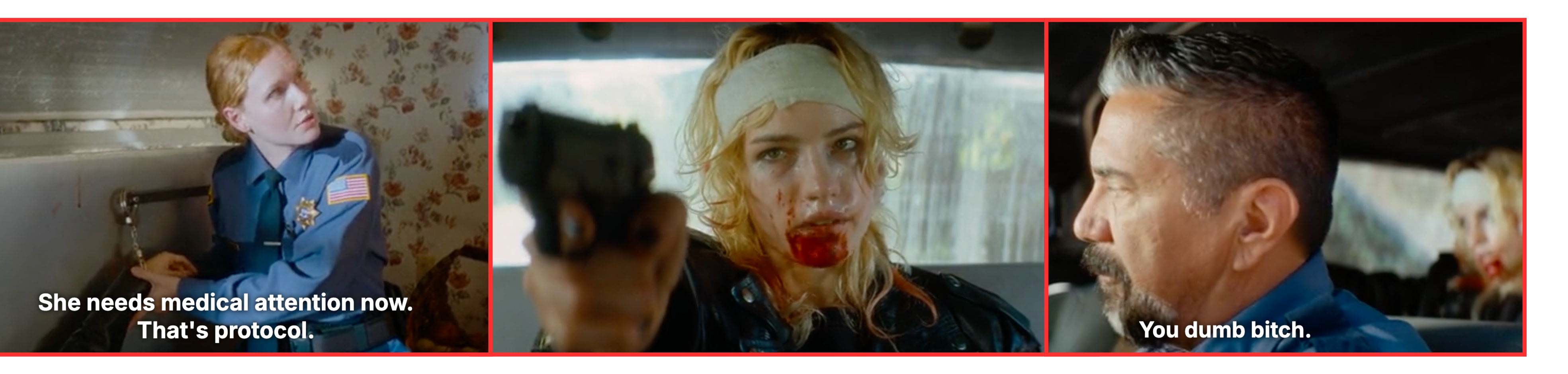
As this review of the movie perfectly says:
“The audience laughs, derisively. They look at this woman, who saw another woman lying helpless on the ground, who probably imagined herself in the exact same scenario, who rushed to help the woman who had surely been through something unimaginably painful, they look at a woman who decided to show empathy, and they are made to laugh at her, for daring to believe that a woman lying on the ground with her pants around her thighs might just have been the victim of sexual violence.”
The Performance of Feminine Distress
The film frames ‘feminine distress’ as a performance, and empathy as naive. It uses the cues of helplessness as a decoy for a murderer who weaponises it against those foolish enough to believe her. But most importantly, it divides the audience into two groups: the female cop, who would rush to help another woman in danger, like a fool, and the male cop who is smart and discerning enough to know that ‘women can lie too.’ The film rewards the latter.
This is what I mean by “hidden in plain sight”—the use of female vulnerability cues to code a villain as purely deceptive and performative. This narrative device is conveyed through two elements: 1) it doesn’t contextualise the violence of our female character as ‘revenge’; the violence needs to be unprovoked, and 2) our character’s violence is contained within a vulnerable-looking exterior that she performs and emphasises deliberately.
It encourages the audience to be suspicious of those who look vulnerable, punishing the protagonists and audience alike for believing the performance of female distress. It validates an “I knew I was right” gut feeling when vulnerable groups are revealed to be dangerous—which is, to say the least, a dangerous idea in this current political climate.
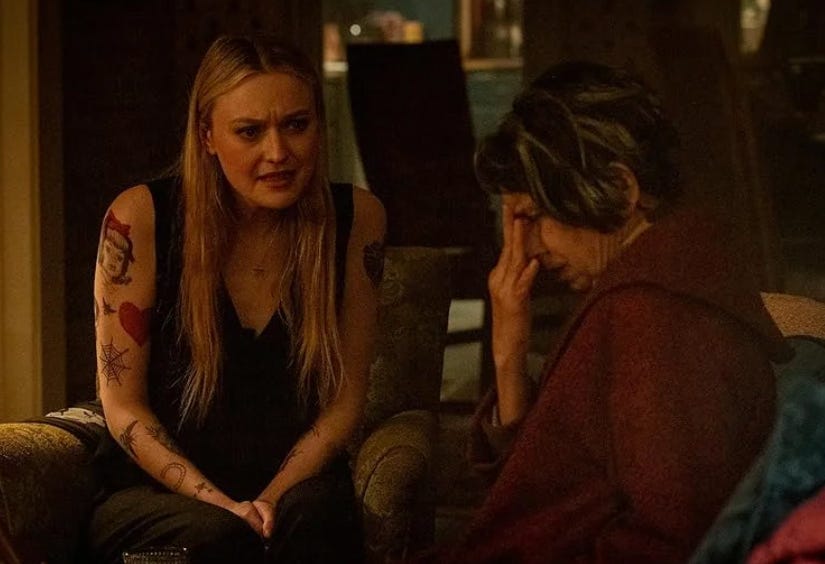
Strange Darling is symptomatic of the post-#MeToo backlash, a reactive depiction of female vulnerability as inherently deceptive. As writer RFQ observed about the overwhelmingly degrading reactions to Amber Heard during the defamation trial in 20225, “a material backlash erupt[ed] in response to a movement that was never allowed to be anything more than aesthetic.”
Strange Darling operates similarly, weaponising anxieties born from a movement that brought visibility but sparse structural change, offering a corrective fantasy to a male audience, where suspicion of women’s claims proves justified.
But “Hidden in plain sight” is far from being a new concept. In Rosemary’s Baby (1968), our protagonist willingly invites Minnie Castevet in her home. Petite, old, with a high-pitched voice, bubbly personality, colorful makeup, and over-the-top friendliness, how could Rosemary ever suspect that Minnie is a witch with a (satanic) plan for her? Rosemary seals her fate the minute she forgets to suspect that Minnie’s vulnerable performance might be a mask for something sinister.
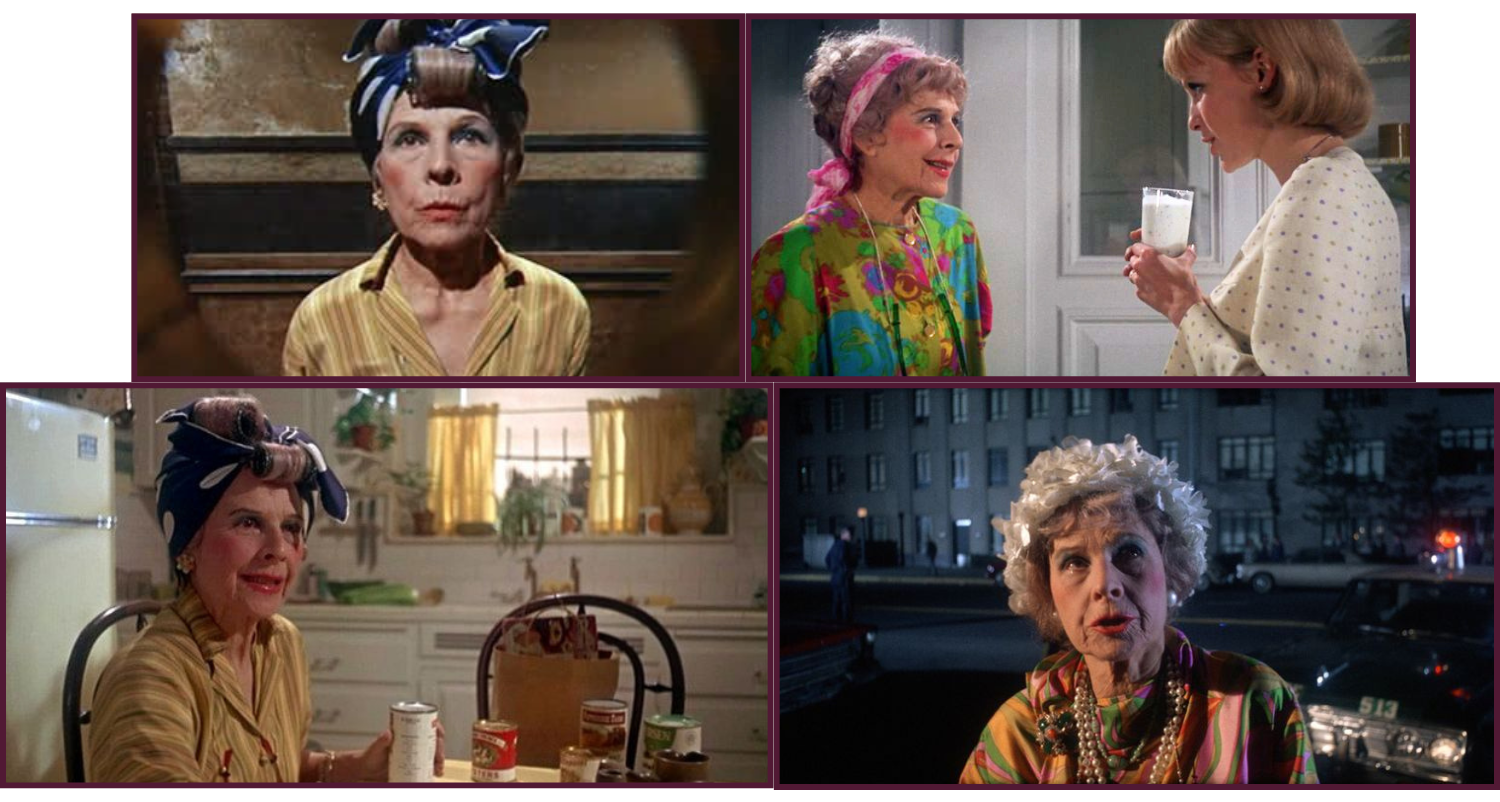
As Payton McCarty-Simas points out6, Minnie was an obvious inspiration for the villain of our second movie, Weapons.
First, They Came for the Children
Weapons starts pretty strong; in a small town, sixteen children from the same class all vanish on a random night. No sign of struggle or premeditation is found; the only thing that’s clear is that all these kids left their house in the middle of the night and never came back.
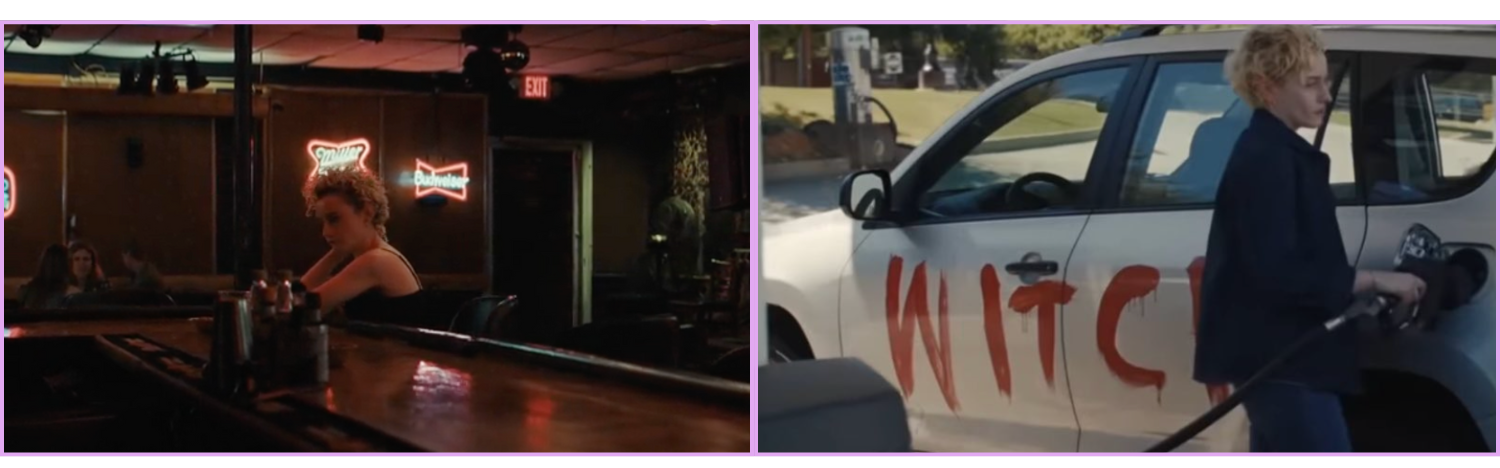
The movie does a good job of dissecting the intricacies of a mass tragedy, and its pipeline from grief to moral panic, especially when children are involved. When something horribly wrong happens in a community, and no clear explanation can be found, there needs to be a scapegoat. So, naturally, all eyes are on the teacher of this class. The parents harass her, convinced that she must have something to do with it. In red letters, someone paints on her car the words “Witch.”
The audience is fully aware that Justine, the teacher, is not a witch. She clearly cares about these children and is just as distraught as the parents when it comes to their sudden disappearance. But the movie frames her as living by herself, involved in a relationship with a married man , and having a slight drinking problem—all deviant characteristics for a woman, which make her the ideal target for a witch hunt
Beginning of spoilers for Weapons
But here’s where the movie’s ‘plot twist’ takes a turn. After building up the tension and the unjustified ‘witch hunt,’ the movie quickly reveals that there actually is a witch in this peaceful little town.
There is a lot to say about how the real witch is depicted. Gladys, the vilain, displays every regressive witch stereotype Barbara Creed identified7. Behind closed doors, her skin is deteriorating, her hair hangs by a thread, and she can be seen vomiting from her condition—tuberculosis—sealing the idea that Gladys is a parasitic witch who has been around for centuries, so desperate to live that she steals the life force of innocents around her.
But when Gladys faces outsiders, she puts on a performance of excessive femininity supposed to put people off her scent: orange wig, excessive makeup, colourful outfits, and a high-pitched voice that drops as soon as the doors close. As this Letterboxd user explains, all these elements “comprise a failed performance of ‘normal’ femininity that instantly marks her out as Other.”8
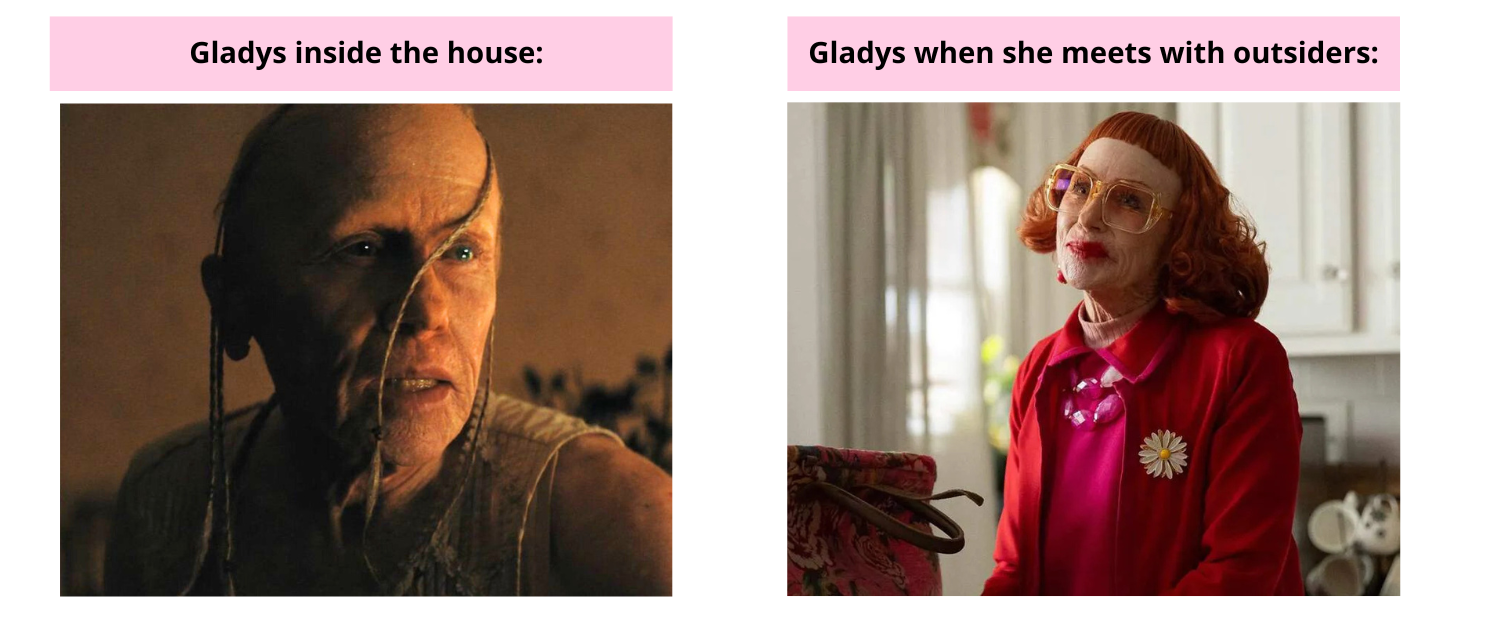
Sure, I trust that the moviemakers had more in mind her potential for Halloween costumes, an opportunity for the movie to market itself. But also, Gladys’ character gets coded as queer in the movie—not necessarily a conscious choice, but one that nevertheless can be found in the subtext.9 Needless to say that this feeds into decades of moral panic and insidiously feeds into the idea that those who are Other and perform femininity are out to get the children.
End of spoilers for Weapons
Gladys perfectly illustrates the idea of “hidden in plain sight” that I’ve been discussing in this essay: vulnerable performance as being a cover for intentional damage of others.
I’ll be honest, I had a good time watching Weapons. It wasn’t my favourite movie of the year, but it had enough twists and turns to make me gasp and cover my eyes. Strange Darling, on the other hand, felt deeply unpleasant from first to last minute.
But regardless of my personal opinion on these movies, what I’ve been trying to convey here is that horror movies are powerful. If horror is a purification ritual that clarifies what is a threat to civilisation, then what are these films conveying to the public by coding vulnerability as deception and empathy as naivety?
Because sometimes, the way evil gets coded in horror doesn’t just reflect our collective anxieties, it feeds into them.
This essay will rely heavily on the work of Barbara Creed in The Monstrous Feminine
In this essay we’ll use the definition of “the abject” as theorised by Julia Kristeva, which refers to things that provoke repulsion (think anything disgusting: corpses, bodily fluids, decay, even the skin that forms on top of the milk) and reminds us that the body is permeable and mortal. The abject must be expelled to maintain “civilised” order (which is why we are repulsed by it)
Throughout this essay, I use “symbolic order” and “civilisation” somewhat interchangeably to refer to the social structures, laws, and categories that define what counts as “normal,” “human,” and acceptable versus what must be excluded as monstrous or deviant. While “symbolic order” is technically a psychoanalytic term (from Lacan) and “civilisation” is broader, following Barbara Creed’s framework, I treat them as overlapping because the symbolic order that horror films restore is fundamentally patriarchal. From a purely academic perspective, this presents some inconsistencies, but for the sake of this essay, it makes sense (trust me).
A great essay and a source of inspiration for this one: Goodbye, Season of the Witch: Weapons Marks the End of an Era for Feminist Witch Films
Rayne Fisher-Quann, Who’s Afraid of Amber Heard?
In The Monstruous Feminine, Barbara Creed says of the figure of the witch: “The witch is also associated with a range of abject things: filth, decay, spiders, bats, cobwebs, brews, potions and even cannibalism,“
I really recommend reading this whole review for a deep-dive analysis of the conservative politics of Weapons
Again, something I’ve learnt from this top-notch review
Sometimes I read a piece and realize I’ve had very wrong ideas about something, and they’re obviously wrong when I start to examine them. Before reading this, I always assumed horror to be a genre by and for those outside the main power structure. This is embarrassing to admit, but I share it because I really appreciate the effort you put into your analysis. You’ve substantially changed my thinking about the genre, and for that I thank you.
When I watched Strange Darling, I actually did like the structure of the film and how it served as a good example of how the form of the thing shapes expectations and perception the story. But the moment we got to the scene where empathy is manipulated and the cop shouts "You dumb bitch." I immediately thought, "Oh no...this is dangerous." I don't expect stories of women to present them in saintly light, and I do want some challenge to absolute ideas, but it wasn't until that moment that I realized, maybe too late, that this film was not actually exploring anything with deftness and instead had a violent singular statement to make about women as predator. It coming off the heels of #metoo just makes it even more obvious, and the fact that the director purposely was coy about "what it all meant" (I haven't followed the film discourse since it came out) solidified that position. I was hoping for subversion, but that that cop line delivered with that tone was all that was needed to understand where this film stood on that matter.
I didn't notice the bit about Weapons, since older women tend to be a favorite horror monster for filmmakers, but I can see it as an interpretation. I'll be curious to see how the prequel with Glady's treats the character, whether it will be one of empathy or go down the road of maintaining monstrosity and threat.